Trading Cards
Charizard holo, 1999 base set
Played condition, one soft corner. Sleeved since forever.
OfferingCharizard holo
WantsAn NFT on Base, or a retro console
A card for a console. An NFT for an NFT on another chain. Something in your wallet for something in the real world. Dot finds the people who have what you want — no prices, no bridge, no cash required.
Played condition, one soft corner. Sleeved since forever.
Real listings, live from the board. Tap one to see it, or say what you'd give for it.
Sign up with your email, list what you have — a card, a console, an NFT — and trade it for whatever you'd rather have.
Ethereum for Base, Zora for Polygon. On the same chain it's one transaction — both move or neither does. Across chains, the board checks on chain that each side still holds theirs.
How cross-chain swaps work →A sealed booster box for a piece of art you love. The NFT is checked on chain, the box gets a ship-by date and tracking, and a no-show is on the record. Digital-for-physical, finally without the leap of faith.
Trading NFTs for physical items →Cards for consoles, by post or meeting up locally. Tracking both ways, four days to send, and every trader's record of trades and no-shows on their card.
Bartering online →The whole app is one loop. If it takes longer than a minute to post something, it's broken.
A title, a line about condition, and what you'd want back. "Open to offers" is a fine answer.
They say what they'd give. You see their dots before you decide, so you know who you're dealing with.
Accepting takes the item off the board. When it's in hand, you each vouch — and you each earn dots.
Barter's oldest problem: you need someone who has what you want and wants what you have. Tell Dot both halves and it goes looking.
In words, or tick whole categories. "Open to offers" counts too.
PS5 or PlayStation 5, Pokémon or pkmn, GBA or Game Boy Advance — read as the same thing.
Both-ways swaps at the top, then nearby traders and listings with Proof of item.
Looking for something nobody has yet? Save it, and get an email the moment it's posted.
The hard part of swapping with a stranger is sending first. Every step of a trade on the board is designed around that.
Every trader shows their dots, how many trades they've finished, how many were verified, and any no-shows — before you agree to anything.
Once you agree, both sides have four days to send. Mark yours sent with a tracking number. If the other side never sends, close it as a no-show — it costs them dots, and everyone can see it.
Each trade has its own message thread that only the two of you can read. Arrange a meetup or a postage plan without posting anything public.
"Near me" uses a location rounded to about a kilometre, enforced by the database. Nobody sees your address unless you send it.
When both sides are NFTs on the same chain, the swap is one transaction: both move, or neither does. Nobody sends first. Listings are checked on chain, so you know it's still held.
Trades are item for item. No cash changes hands between traders and no card numbers are stored here, so there's nothing in the middle to lose.
A barter board runs on whether you can trust a stranger. Dots are the only answer to that, so they're the one thing the app guards.
Dots aren't stored as a number anyone can write. They're counted from the trade record itself — every dot traces back to a swap somebody else accepted, or a vouch somebody else left. Trading back and forth with the same person stops counting after the second time, so two friends can't manufacture a reputation. There's nothing to edit and nothing to buy.
That's where swapping is liveliest, so that's where the board starts — trading cards, video games, retro consoles and collectibles.
And everything else, from bikes to vinyl:
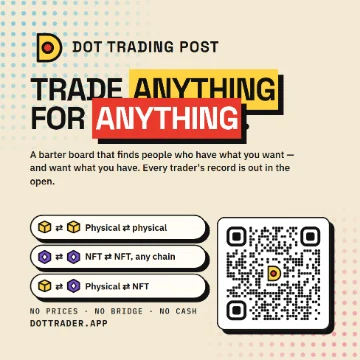
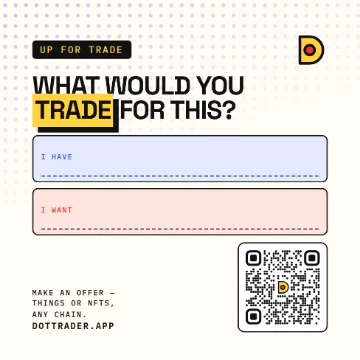
Six stickers for trade binders, console boxes, laptops and meetup tables. Every QR code opens the board.